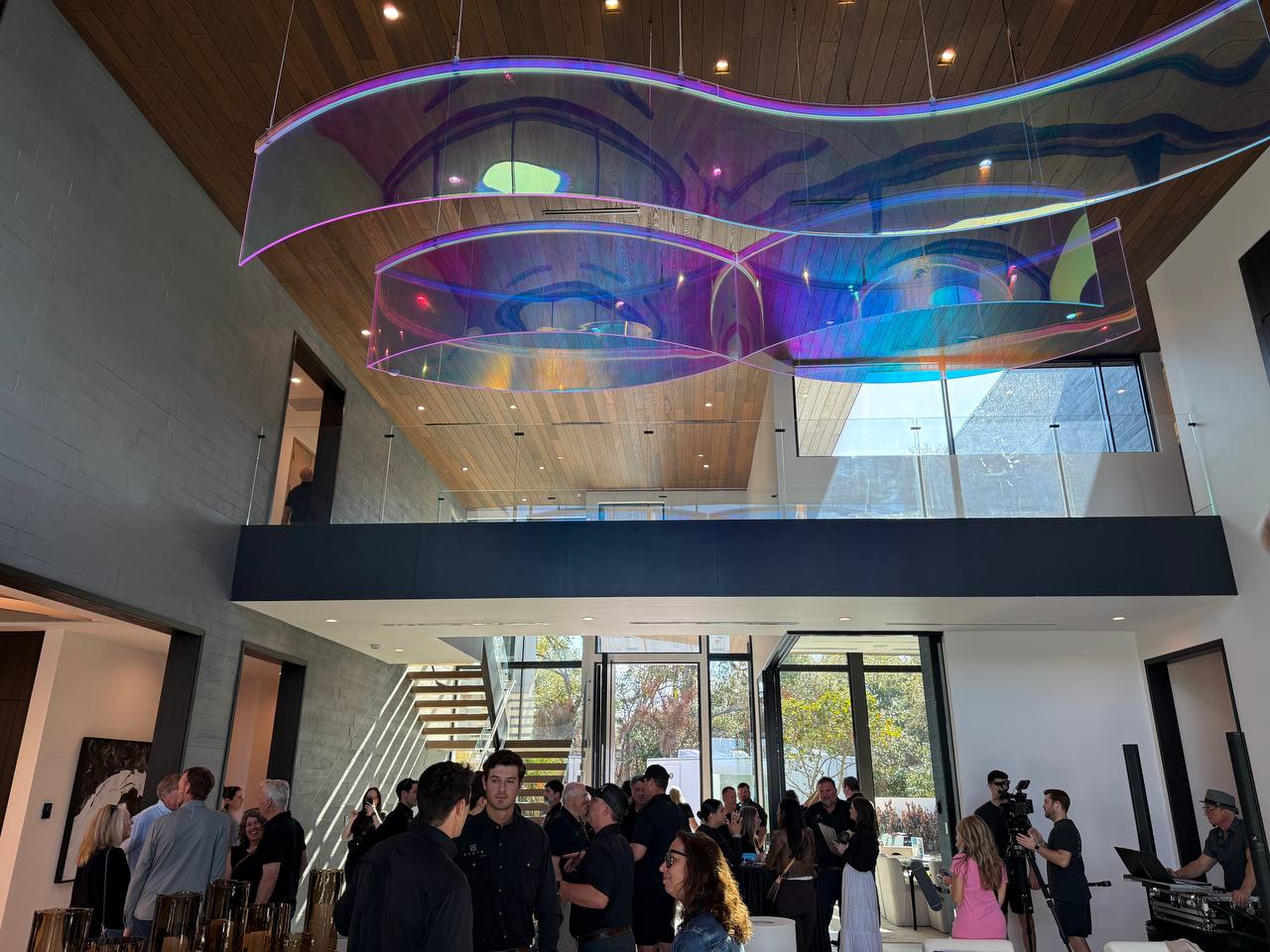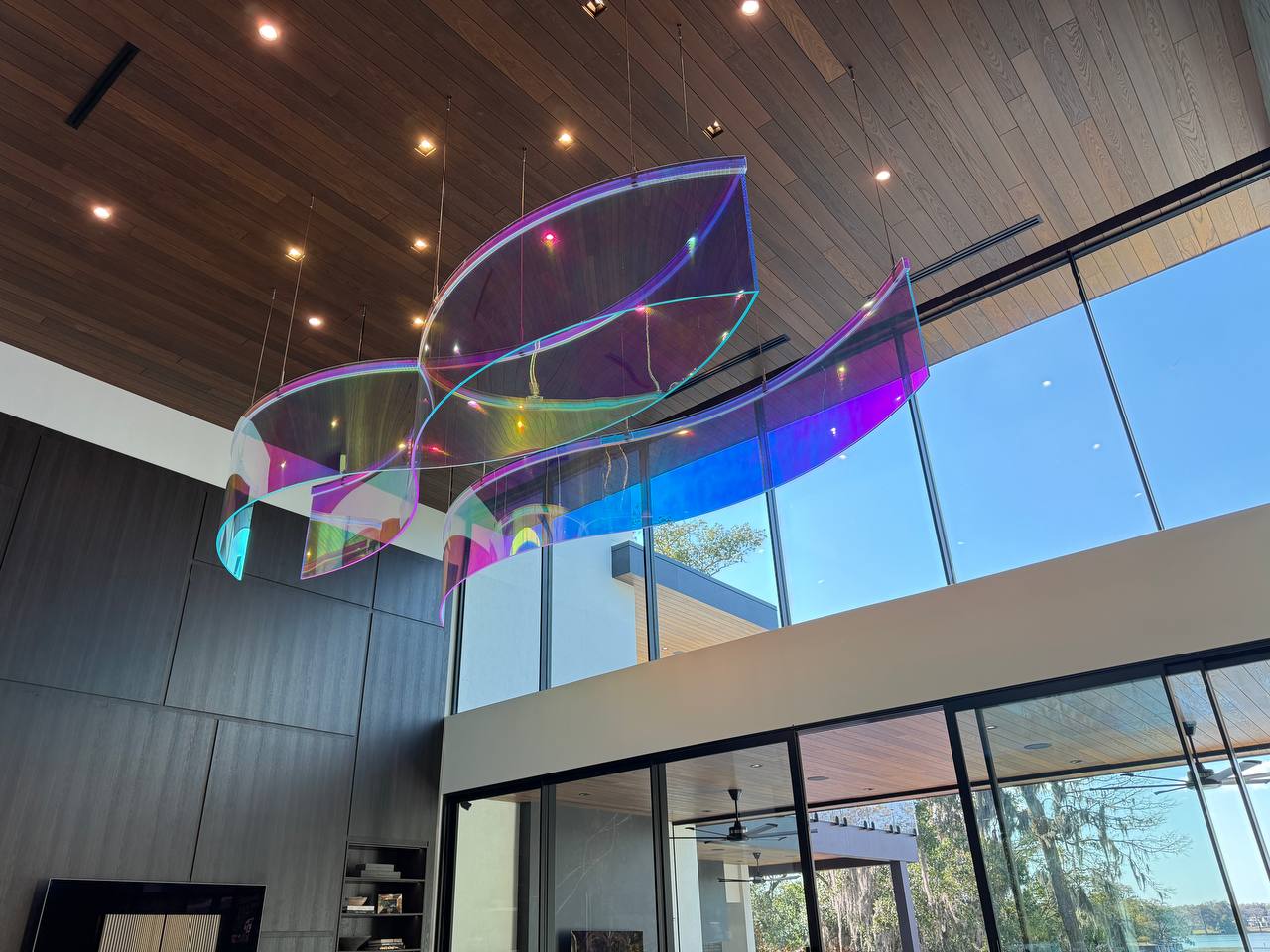
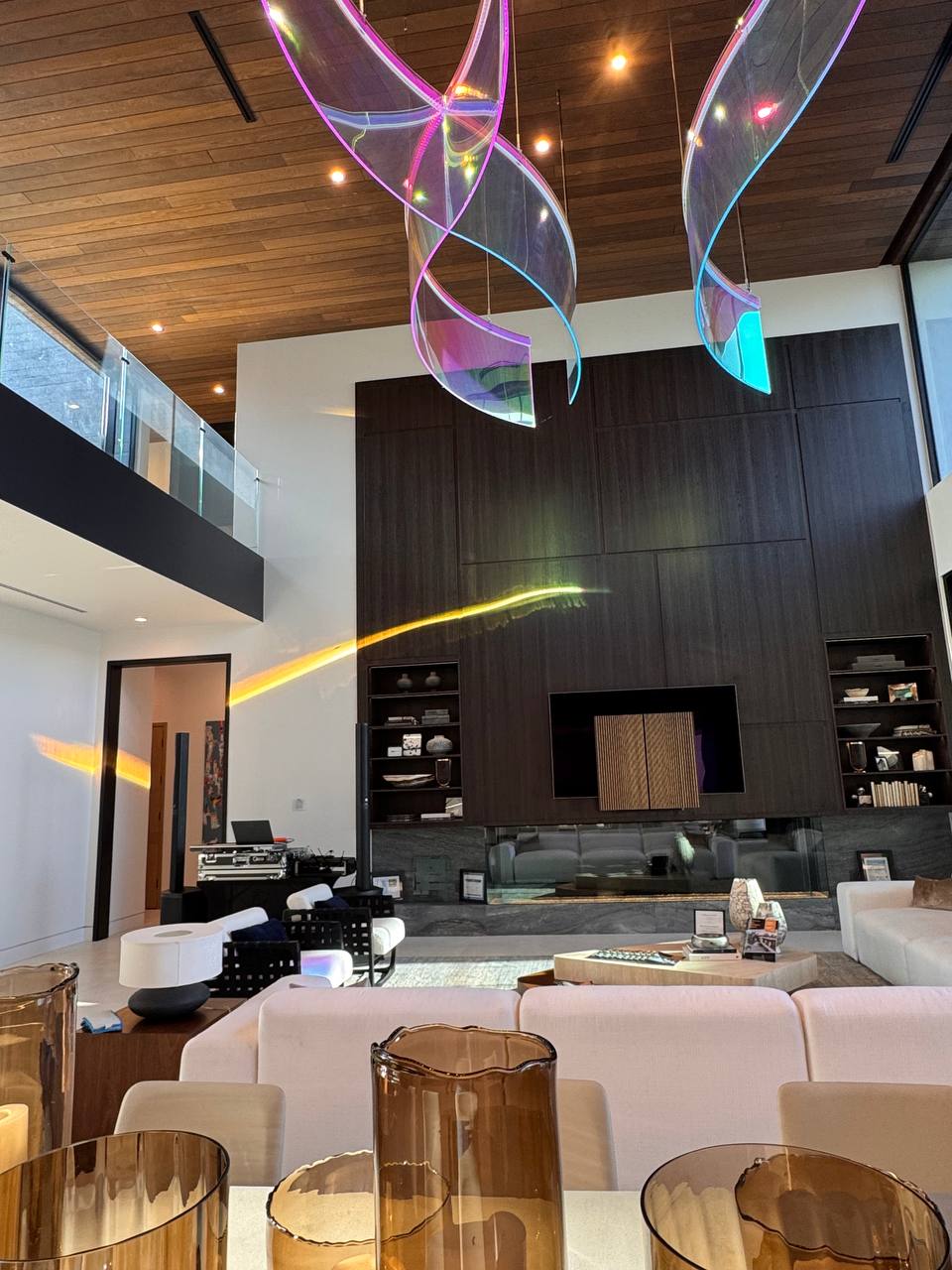
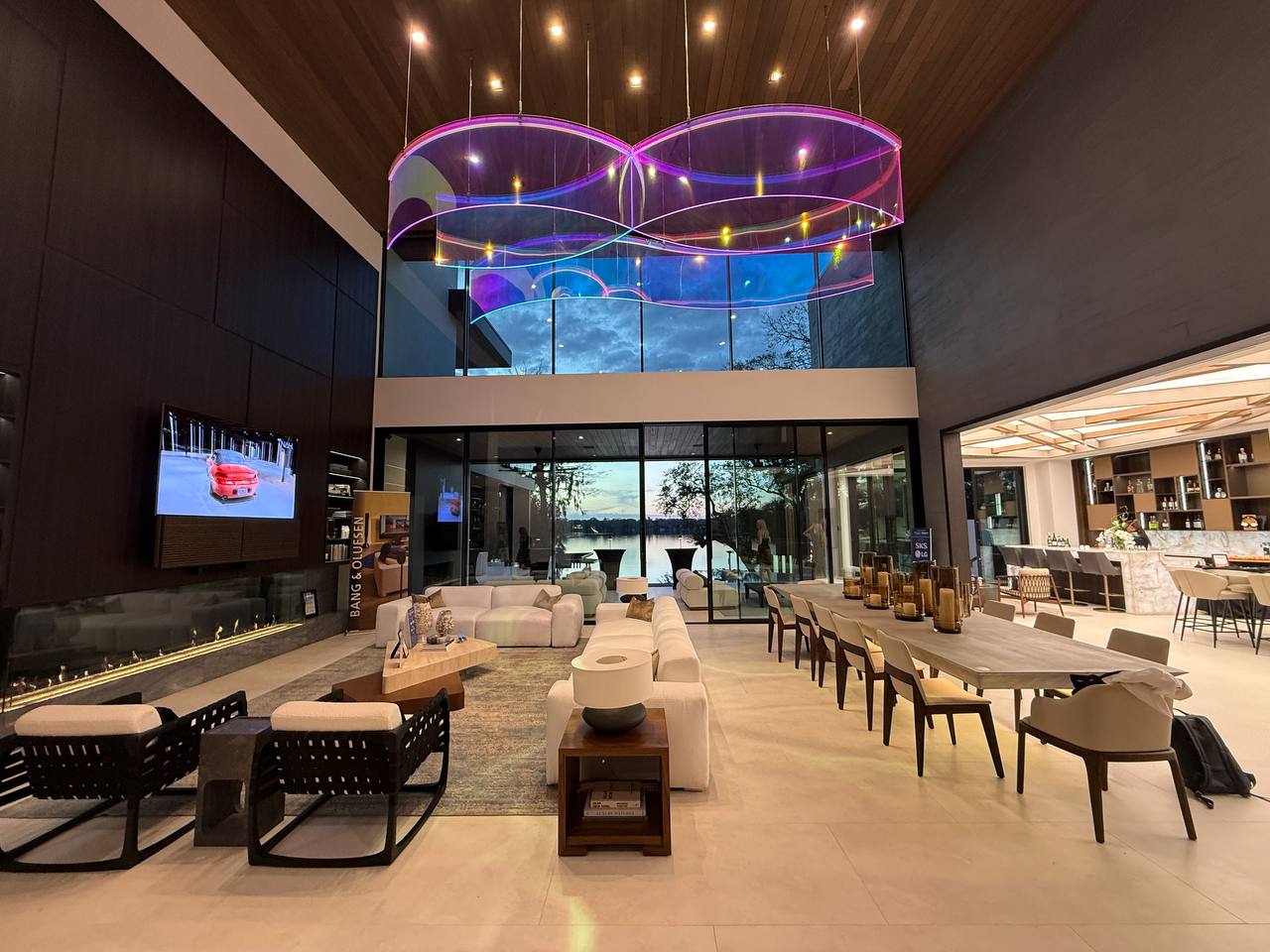
There's a moment that happens every afternoon at the New American Home in Kissimmee. Around 4:30, as the sun drops toward the treeline, the entire two-story entry floods with color. Not from LEDs. Not from a projector. From sunlight passing through dichroic acrylic panels suspended 20 feet in the air, splitting into prismatic rainbows that sweep across the walls, the floor, and anyone standing in the space.
People stop talking when it happens. I've watched it a hundred times and it still gets me.
That piece is called Spectral Wake, and it's become one of the projects I'm most proud of. But the real star isn't the sculpture itself. It's the material: dichroic acrylic. And I think it's one of the most underappreciated mediums in contemporary art and design.
What Is Dichroic Material?
The word "dichroic" comes from Greek, literally meaning "two-colored." It refers to a material that transmits one color of light while reflecting another. The effect is created by applying ultra-thin layers of metallic oxides to glass or acrylic, each layer tuned to interact with a specific wavelength of light.
The result is something that looks different depending on how you look at it. Walk around a piece of dichroic glass and the colors shift continuously. Tilt it in sunlight and the reflected color might be gold while the transmitted color is deep blue. Turn it 10 degrees and everything changes. It's the same material doing completely different things to different wavelengths of light at the same time.
If that sounds like it shouldn't be possible, welcome to thin-film optics. The same physics that makes soap bubbles iridescent, just engineered with intention.
Why Artists Are Obsessed with It
I'll tell you why I'm obsessed with it, and then you can decide if it tracks.
Most art is static. A painting looks the same at noon as it does at midnight. A steel sculpture catches different light throughout the day, sure, but it's still fundamentally the same object delivering the same experience. Dichroic material isn't like that. A dichroic installation is a collaboration between the artist, the architecture, and the sun. The piece literally changes every minute of the day, every day of the year.
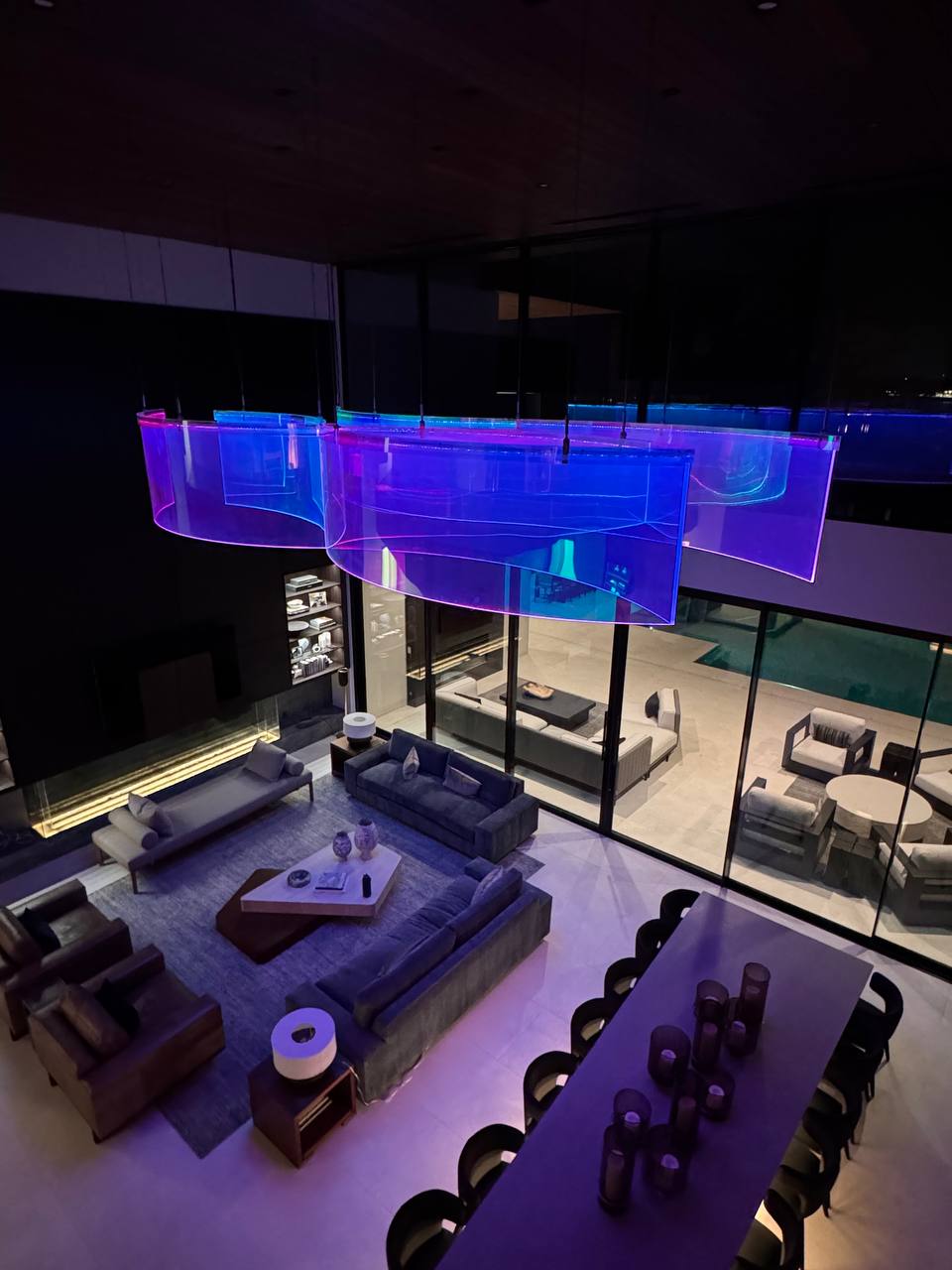
At 8 AM, the light hits at a low angle and you get these long, stretched prismatic ribbons running across the floor. By noon, the beams are tighter, more intense, concentrated pools of pure color. At golden hour, the whole space ignites. After sunset, the material becomes reflective and moody, catching interior lighting and ambient glow.
You can't photograph it. I mean, you can take beautiful photos, but no single image captures what it's like to stand in a space that's actively changing color around you. It's temporal art. It exists in time, not just in space.
"A house built by light, now painted by it."
The Science (Without the Textbook)
Here's the short version of how it works.
White light from the sun contains every visible wavelength. When it hits a dichroic surface, some wavelengths pass through and some bounce off, depending on the specific coating and the angle of incidence. The transmitted light and the reflected light are complementary colors, meaning together they'd add back up to white.
Change the angle and you change which wavelengths get transmitted versus reflected. That's why the color shifts when you move. It's not a trick, it's physics. Every position in the room gets a different slice of the spectrum.
The coatings are incredibly precise. We're talking layers measured in nanometers, thinner than a wavelength of light itself. Different coating formulas produce different color behaviors. Some shift from magenta to cyan. Some go from amber to deep violet. Some create intense, narrow bands of color, and others produce wide, gentle gradients.
For Spectral Wake, we worked with panels that shift across a broad range, specifically because we wanted the space to feel alive, not just colorful. We wanted visitors to experience something different every time they walked through.
Building Spectral Wake
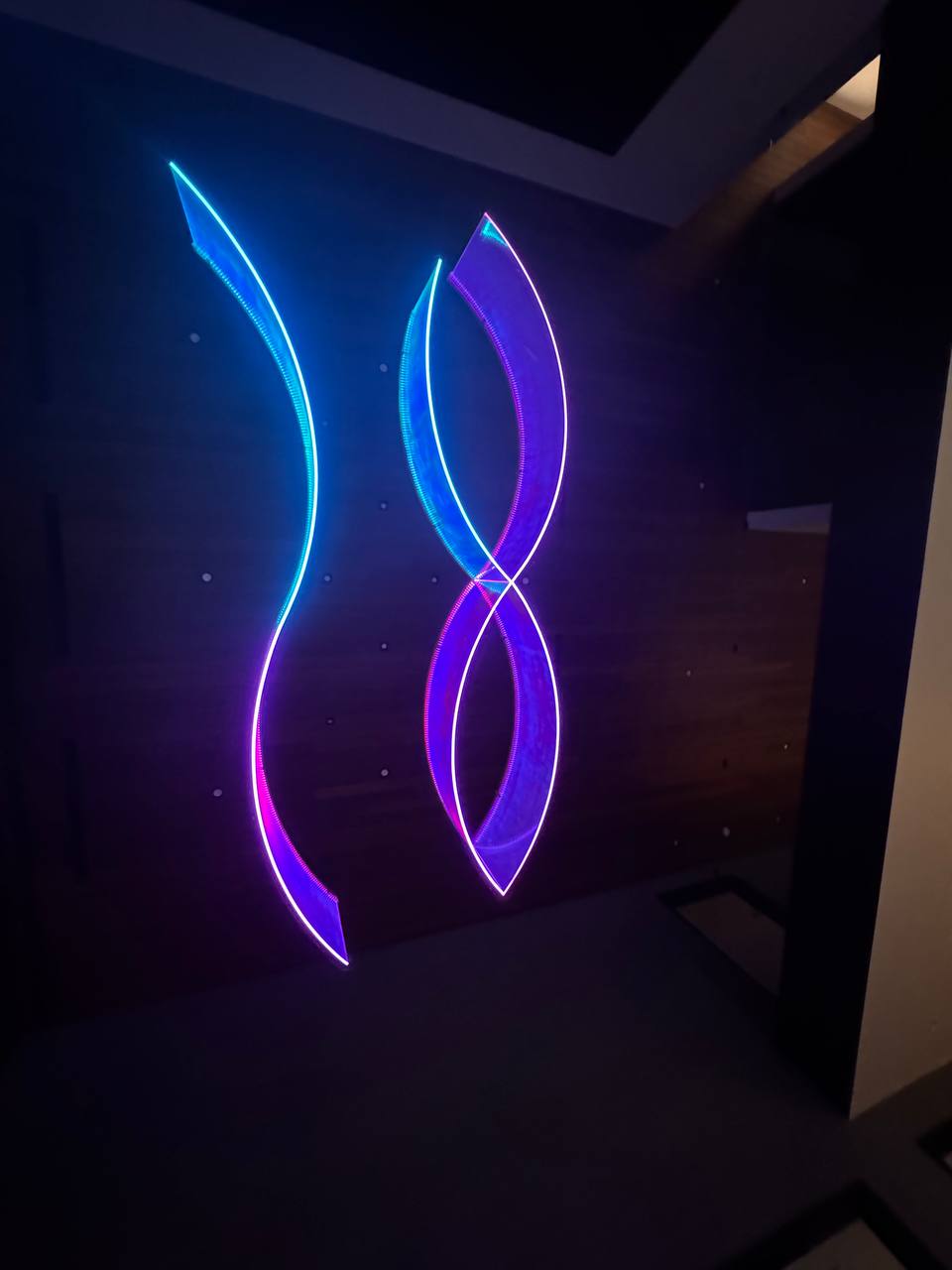
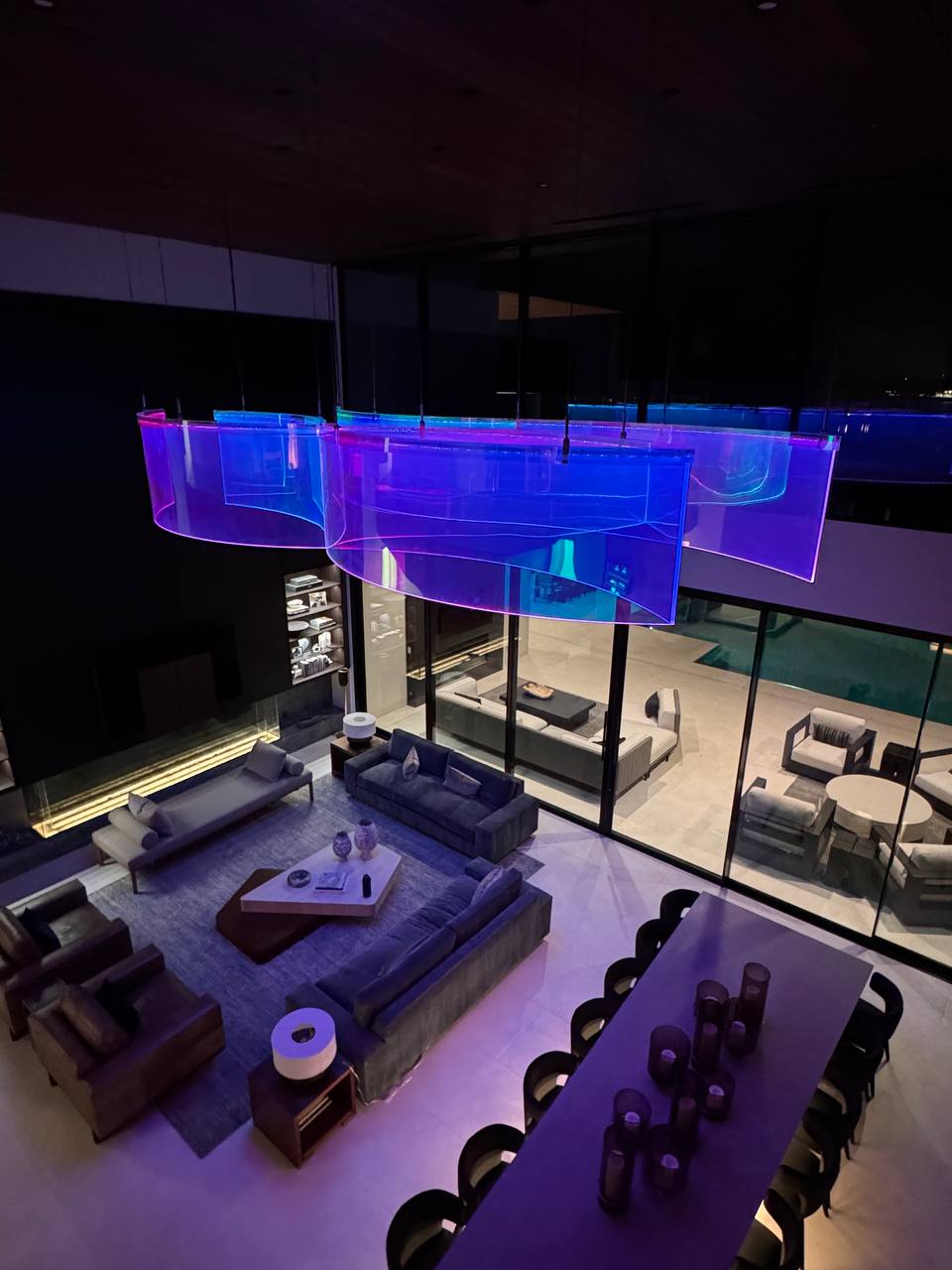
Spectral Wake wasn't a simple "hang some pretty panels" job. It's a 600-pound suspended sculpture in a double-height entry, and every decision, from material selection to mounting angle, was driven by how light would interact with the space.
My friend Jason and I started talking about this project at Burning Man, of all places. We'd been sketching ideas about light and geometry for years. When the opportunity came to design an installation for the New American Home 2026, we knew immediately it had to be dichroic. The entry had this soaring two-story volume with a west-facing window wall. It was practically begging for prismatic light.
We designed the piece as a series of triangular dichroic panels arranged in a geometric formation, referencing sacred geometry and wave patterns. The triangular forms overlap and angle differently, so each panel refracts light in a slightly different direction. Instead of one big rainbow, you get this complex, layered field of color that wraps around the room.
The engineering was real. Six hundred pounds of acrylic and aluminum, suspended from structural cables anchored into the ceiling joists. We had to model the installation in 3D and run stress calculations on every connection point. The fabrication took months, cutting each panel to precise angles, drilling mounting points, building the suspension framework.
Dichroic vs. Other Light Art
I work with LEDs a lot. I love LEDs. But dichroic material does something fundamentally different.
LED art is active. You program it, control it, schedule it. The artist decides exactly what happens and when. That's powerful, and it allows for incredible dynamic experiences. But it runs on power, software, and hardware that eventually needs maintenance.
Dichroic art is passive. The sun is the power source, physics is the software, and the material is maintenance-free. There's no control system to crash, no firmware to update, no pixels to die. It just works. The same physics that made the piece beautiful the day it was installed will make it beautiful in 50 years.
That permanence matters to me. When I think about the kind of art I want to make at scale, the installations that define places for decades, I keep coming back to materials that don't need a power outlet. Light, geometry, physics. Those don't depreciate.
That said, the most interesting work often combines both. Imagine a dichroic sculpture that performs with sunlight during the day, then gets washed with programmable LED light at night, extending its performance to 24 hours. We're exploring exactly this kind of hybrid approach in upcoming projects.
Where Dichroic Works Best
Not every space is right for dichroic. The material needs light to perform, and the best results come from spaces with strong directional sunlight. Here's where it really sings:
- Atriums and lobbies with skylights or large window walls, the more sun, the more color
- Building entries where the piece is the first thing visitors experience
- Outdoor installations in plazas, parks, and building facades, full sun exposure means maximum effect
- Stairwells and vertical spaces where light can cascade down through multiple levels
- Residences with dramatic architectural volumes, the New American Home proved this beautifully
- Hospitality spaces, hotel lobbies, resort common areas, anywhere you want guests to stop and look up
The orientation matters enormously. A west-facing window will give you dramatic late-afternoon performances. East-facing works for morning light. South-facing gets the most consistent sun throughout the day. We study the solar path for every site before designing a dichroic installation, because the sun is literally our co-designer.
Commissioning Dichroic Art
If you're a developer, architect, or property owner thinking about dichroic for a space, here's what to know upfront:
Budget. Dichroic material isn't cheap. The coated acrylic and glass panels are specialty products, and the fabrication requires precision. A mid-scale installation typically starts around $50,000-$100,000, with larger commissions running significantly higher. But unlike LED or projection, there's no ongoing power cost, no software licensing, and virtually zero maintenance.
Lead time. Plan for 4-6 months from concept to installation. Material sourcing takes time, and the design process requires careful solar analysis and engineering.
Integration. The best results come from involving the artist early in the architectural design process. If we can influence window placement, ceiling heights, and surface materials, the installation performs dramatically better than when we're adapting to a finished space.
We've put together a full guide to commissioning public art if you want to understand the process from start to finish.
What Comes Next
Spectral Wake was a proof of concept for something bigger. The idea that you can make an entire space feel alive, emotional, and constantly changing using nothing but material science and geometry. No power. No programming. Just light doing what light does, guided by intentional design.
I've got bigger plans for dichroic. Outdoor sculptures in public plazas. Façade installations that transform entire buildings. Pieces at a scale where the prismatic color isn't just in a room, it's in a park, a street, a skyline. The material scales beautifully because the sun doesn't run out of lumens.
If you've never experienced dichroic art in person, I'd genuinely encourage you to seek it out. Photos are beautiful but they can't capture the feeling of standing inside light that's alive. It's the closest thing I know to making the invisible visible, taking white sunlight that's always been there and revealing the hidden spectrum inside it.
That's what art should do. Show you something that was there all along.
Explore our art & experiences → · Start a conversation about your space →