I've walked through dozens of hotel AV installs across Orlando, and you can spot the difference between good design and bad design the moment you step into a ballroom. The good ones, you don't think about the AV at all. The sound is even. The mic works. The video is clear. It just happens. The bad ones? You're immediately aware something's off. The audio is loud in one corner and dead in another. The staff struggles to switch inputs. The system fights back instead of helping.
The difference isn't usually the equipment. It's the approach.
Why Single-Platform Approaches Fail
Here's what I see most often at struggling properties: layers and layers of different gear. A DSP from one vendor, a matrix switcher from another, touch panels that don't talk to each other, control systems that require proprietary knowledge to manage. It's the Frankenstein approach, and it sounds like it works until something breaks or needs to change.
The problem with single-platform thinking is that it leaves you locked into one vendor's ecosystem, with their limitations and their support timelines. It also means every zone needs custom programming, every change requires truck rolls, and your staff either needs advanced training or they're just hitting buttons and hoping.
At Royal Pacific Resort, Loews Portofino Bay, and Hard Rock Orlando, they've all moved toward networked systems with centralized control. The difference is immediate. You get flexibility without complexity.
What Good Hotel AV Design Actually Requires
Orlando properties face unique challenges. You've got themed environments that need to maintain their acoustic character. You've got ballrooms that go from corporate breakfast to evening cocktails to late-night dancing, each needing different audio signatures. You've got pool decks where sound needs to carry outdoors. You've got restaurants where speech clarity matters as much as music quality. And you've got 24/7 operations where downtime isn't an option.
Any serious hotel AV design needs to handle this:
- Zone independence, one space operates without affecting others
- Source flexibility, staff can route audio and video from any input to any output
- Scalability, adding a new space or expanding an existing one shouldn't require redesigning the entire system
- Remote support, your AV team can troubleshoot and adjust without being on-site every time
- Simple staff interfaces, your banquet team, pool manager, and restaurant staff should be able to run it without becoming AV engineers
- Redundancy, critical systems have backups so a single failure doesn't take down your entire property
How We Approach It Differently
We're not just integrators. We're artist-engineers. We think about how your property actually works before we spec a single piece of equipment. We walk the spaces with your ops team. We understand what the banquet captain really needs, what the restaurant manager struggles with, where the sound problems actually live.
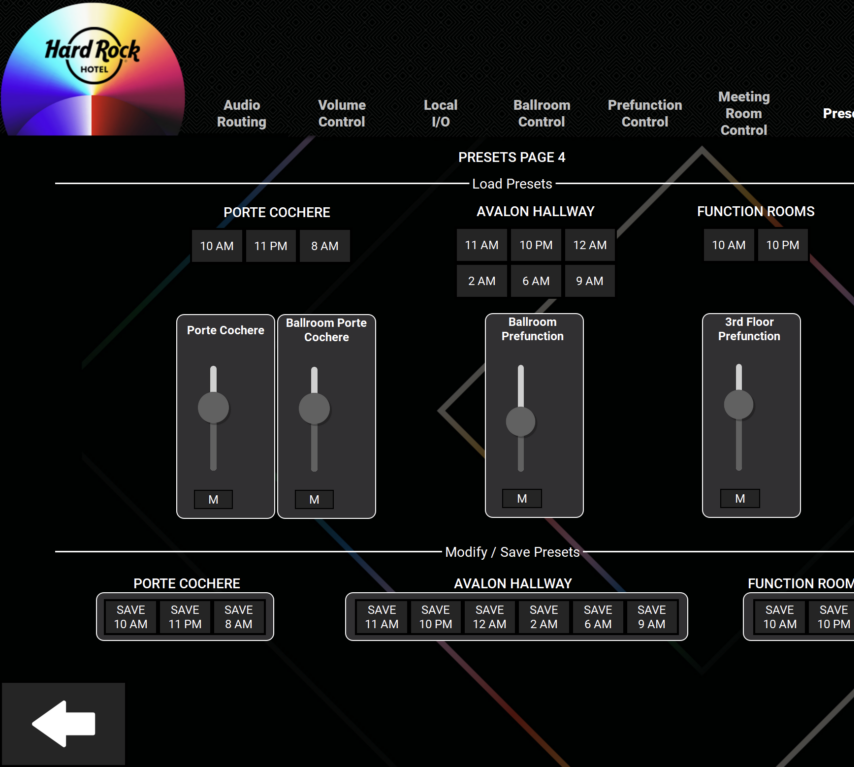
Then we design a backbone that's vendor-agnostic but deeply cohesive. Networked audio and video means we're not limited by proximity or old copper runs. Centralized control means one platform manages everything while giving each department exactly what they need to see. And crucially, we design for your team, not against them.
At Four Seasons Houston and Cabana Bay, we built systems that adapted to how the properties actually operated, not how they were supposed to operate. That's the difference between a spec sheet and a system that works.
The Support Side
Good hotel AV design also means you're not calling the integrator three times a week. We build systems that are easy to maintain, hard to break, and when something does go sideways, we're already monitoring it remotely. Most issues get fixed before anyone notices. For the ones that need hands-on work, we can usually fix it without a truck roll because the system is designed to be remotely manageable.
"The best AV system is invisible. Your guests don't think about it. Your staff doesn't struggle with it. It just works, every time."
What Gets Most Hotels Wrong
Trying to save money on integrators. Choosing equipment based on price instead of architecture. Assuming the system they install will be the system they'll be running five years from now. Not planning for growth. Not thinking about who's actually going to operate it every day.
The cost of bad AV design compounds. It's staff frustration every time they use it. It's guest experiences that feel off. It's expensive on-site support calls. It's system upgrades that cost more than they should because the foundation was wrong to begin with.
Good design costs less over the life of the system because it works first and scales cleanly.
Ready to Rethink Your Hotel AV?
If your property is running on aging infrastructure or you're planning a renovation, the difference between good and bad hotel AV design is where you start. Not with a price quote. With a conversation about how your property actually works.
Let's talk about what a modern hotel AV system could look like for your property.