It's Never Just "The LED Wall"
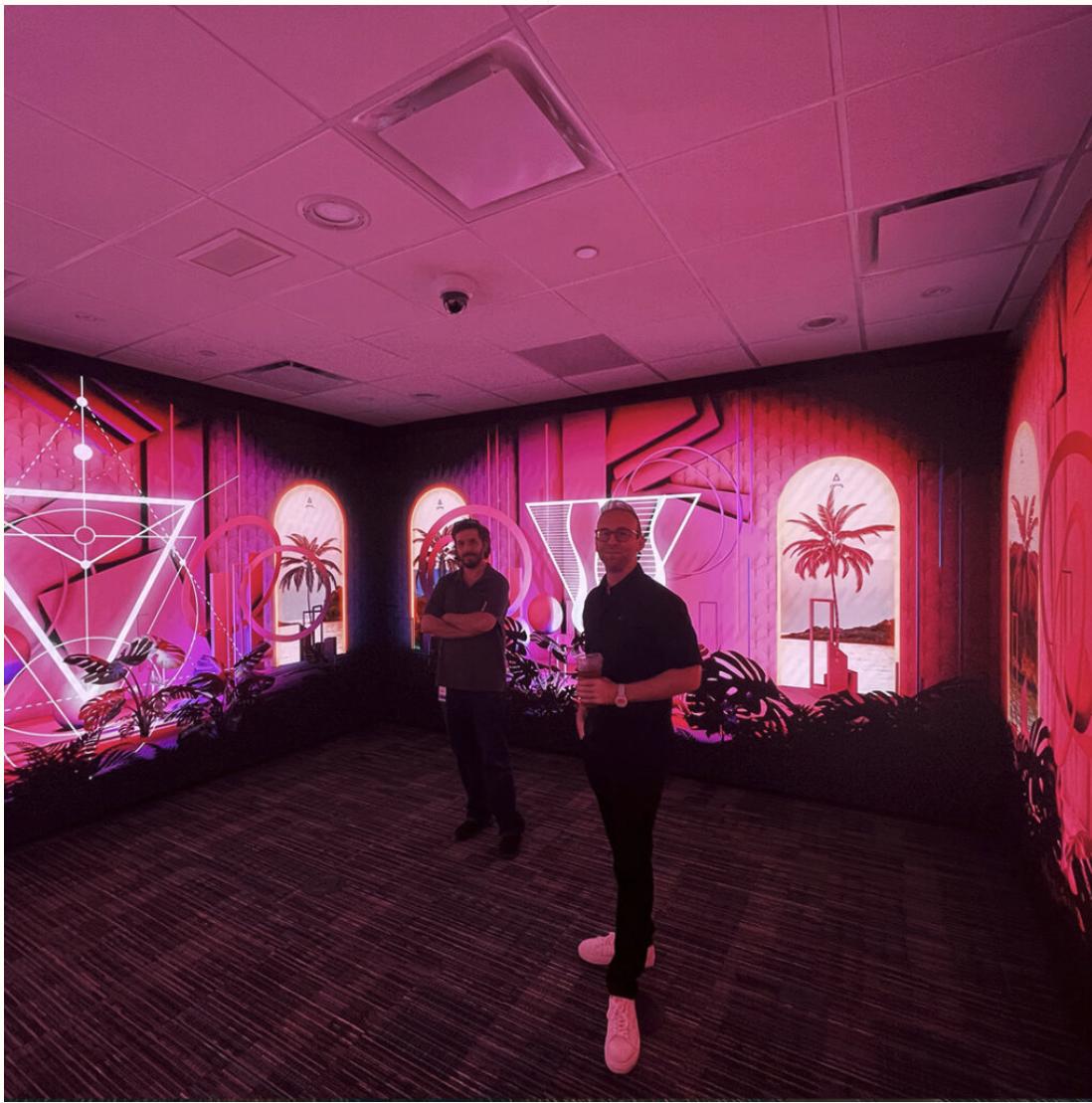
People walk into a finished immersive room and say "look at that LED wall," and I get why, the video is the part your eyes land on first. But an immersive room is never really about one wall. It's about four separate systems, video, audio, lighting, and control, engineered from day one to operate as a single organism instead of four things that happen to share a floor plan. Miss that integration and you get an expensive room full of screens that never quite feels alive.
We've built these rooms for corporate briefing centers, museum galleries, and experiential art installations, and every one of them comes down to the same four disciplines stacked correctly. Here's what's actually inside one.
The Video Layer: Wall, Floor, and Sometimes Ceiling
Full 360-degree immersive rooms typically use fine-pitch LED panels, often in the 1.2mm to 1.9mm pixel pitch range for close-viewing environments, tiled across walls, and increasingly across the floor as well, since walkable LED flooring has gotten durable enough for real foot traffic. Ceiling integration is rarer because of structural and heat-load considerations, but when a project calls for full overhead coverage, it's absolutely being done in high-end immersive spaces today.
The hard part isn't hanging panels, it's making the seams between wall and floor, or between adjacent wall sections, disappear from the content itself. That requires accurate 3D mapping of every panel's physical position and warping the video content to match, so a single continuous image can wrap around a corner without a visible break. Get the geometry wrong by even a few millimeters and the whole illusion collapses.

Spatial Audio: Sound Has to Move Like the Video Does
A visual that wraps around you but sound that comes from two speakers up front breaks the immersion instantly. Real immersive rooms use object-based or multi-zone spatial audio, speaker arrays positioned around and sometimes above the room, driven by a processor capable of panning discrete sound objects through 3D space in sync with what's happening on screen. If content shows something moving from the back-left of the room to the front-right, the audio needs to travel that same path in real time, not just play generically from all speakers at once.
This is one of the areas where system design matters more than any single piece of gear. The DSP architecture, the number of independent audio zones, and how tightly the audio engine is locked to the video timeline all determine whether spatial audio actually reads as spatial, or just as "loud from everywhere."
Lighting: The System Most Rooms Get Wrong
Ambient and architectural lighting in an immersive room isn't decoration, it's a synchronized show layer, same as the video and audio. Practical lighting fixtures (uplights, accent washes, sometimes moving fixtures) need to shift color temperature and intensity in lockstep with on-screen content, reinforcing whatever mood the video is building rather than sitting on a static "on" setting the whole time.
The technical requirement here is that lighting fixtures need to be addressable from the same show control timeline driving video and audio, typically over DMX or a network lighting protocol, with cues programmed frame-accurately alongside the content, not adjusted live by a tech with a slider.
If the lighting isn't cued to the same timeline as the video, you don't have one immersive room, you have three rooms in a trench coat.
Control: The Nervous System Holding It Together
Everything above is meaningless without a unified control backbone tying it together. This is typically a dedicated show control system or a networked AV control platform (Q-SYS-based audio DSP is common here, alongside dedicated media servers for video and DMX/lighting controllers), all triggered from one timeline, one playback engine, one "go" button. When a show starts, every system, video frame, audio object position, lighting cue, needs to fire from the same clock, down to frame-accurate sync.
We typically bring in specialized programmers for the deeper show-control scripting on complex rooms, but the system architecture, how many zones, how many control points, how content gets triggered and looped, gets designed up front, because retrofitting unified control onto four already-built independent systems is far harder than designing for it from day one.
- Video: fine-pitch LED walls (and often floors) with precise 3D panel mapping
- Audio: multi-zone or object-based spatial sound locked to the video timeline
- Lighting: addressable fixtures cued frame-accurately alongside content, not run on manual settings
- Control: one unified show control backbone triggering all three simultaneously
Content Pipeline: Built for the Room, Not Just Played in It
None of this works with off-the-shelf video content. Immersive room content has to be authored specifically for the room's exact panel geometry, resolution, and aspect ratio, a 3-wall wraparound room and a full 360-degree dome need completely different content masters. That means the content pipeline (whether in-house or through outside creative partners) has to work hand-in-hand with the system integrator from the earliest design phase, not get handed a finished video file after the room is already built.
Done right, all four layers disappear into a single experience, a guest doesn't clock the LED wall, the speaker array, the lighting rig, or the media server. They just feel like they're somewhere else. That's the whole goal, and it's the same discipline whether we're building a themed attraction or a corporate briefing center. If you're scoping an immersive room project, our LED video wall team can walk you through what your space and budget can actually support, get in touch and we'll start there.