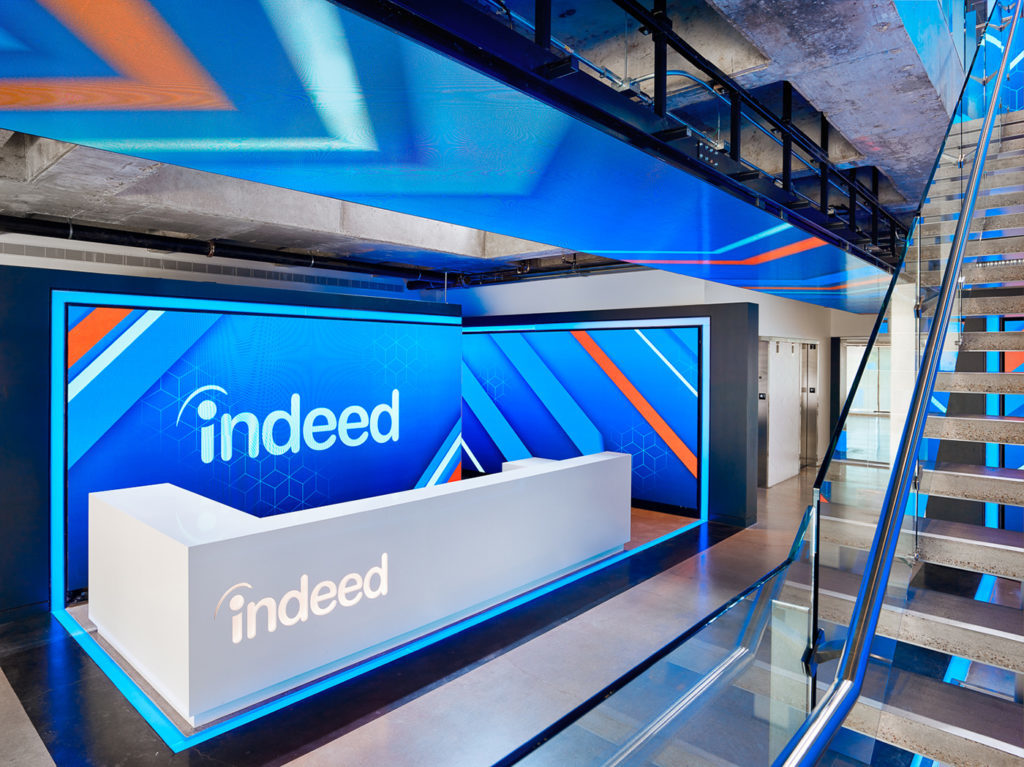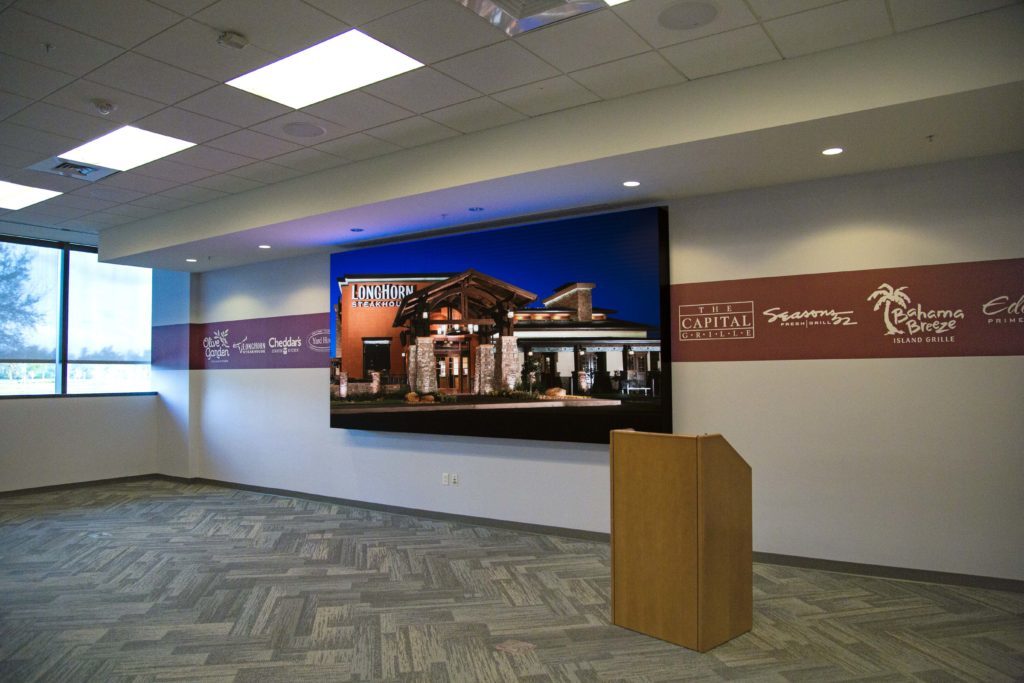
I still remember the first time a client asked me for an LED wall for a space where people would be standing four feet away from it. My gut reaction was no — that's not what this stuff is for. LED was for arenas, highway billboards, big open plazas where the pixels could hide behind distance. Up close, you'd see the grid. You'd see the seams. It would look cheap in the worst way.
That reaction is about eight years out of date now, and if you're evaluating direct view LED for your lobby, boardroom, or retail storefront, it's worth understanding exactly what changed — because it wasn't marketing. It was physics and manufacturing catching up to the demand.
The Stadium Problem
Direct-view LED works by building an image out of thousands of individual light-emitting diodes, usually clustered in red-green-blue trios, mounted on modular panels called cabinets. The first commercial LED walls had a big physical constraint: how close together can you actually pack those diodes before manufacturing costs and heat management make it impractical? For a long time, the answer put the diodes 10, 16, even 20 millimeters apart. That's fine when your audience is sitting 150 feet from the screen. It's a mess of visible dots when they're standing in your reception area.
That gap between diodes has a name in the industry, and understanding it is the whole key to speccing an LED wall correctly.
What Pixel Pitch Actually Means
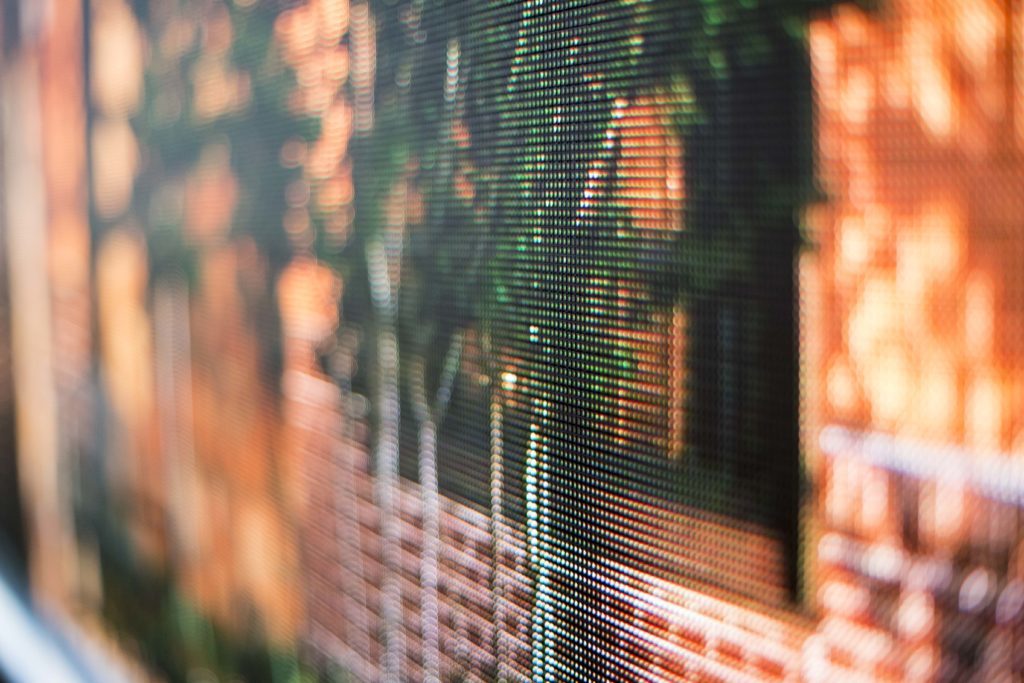
Pixel pitch is simply the distance, in millimeters, between the center of one pixel and the center of the next one. A P10 wall has 10mm between pixels. A P1.5 wall has 1.5mm between pixels. Smaller number, tighter pixel density, sharper image up close.
There's a rule of thumb we use with clients to translate pixel pitch into something useful: minimum comfortable viewing distance in feet is roughly the pixel pitch in millimeters. A P4 wall wants viewers standing at least 12-13 feet back before the image resolves cleanly. A P1.5 wall holds up at 5-6 feet. That's the entire reason fine pixel pitch mattered — it moved the "comfortable" zone from the parking lot to the conference table.
Why the Price Dropped (and Why It Still Isn't "Cheap")
Ten years ago, sub-2mm pixel pitch was a premium, boutique product — think flagship retail installs and broadcast studios with budgets to match. Today it's a normal spec conversation for a corporate lobby or a boardroom. What changed is manufacturing scale: as consumer and commercial demand for fine pitch LED grew (driven heavily by Asian display manufacturers investing in mass production of smaller SMD and COB packages), the cost per square foot for tight pixel pitch dropped dramatically — in some categories by well over half in under a decade.
That doesn't mean it's cheap in absolute terms. A finished, professionally installed direct-view LED wall is still a five-figure-and-up investment once you account for the display itself, the structural mounting, the media processing, and integration labor. But it moved from "not realistic for this project" to "let's actually compare it against other options" for a huge range of commercial spaces.
Fine pixel pitch didn't make LED cheap. It made LED appropriate for rooms where people actually stand close to the screen.
When It Makes Sense vs. When It Doesn't
I turn down LED recommendations more often than people expect, because it's not always the right tool. Here's how I actually think about it with clients:
- Bright ambient light, glass lobbies, direct sun exposure — LED wins easily; projection washes out.
- Content changes daily or needs to run 12+ hours a day — LED handles duty cycle far better than a projector bulb or laser engine.
- Tight budget, occasional-use screen, controllable room lighting — projection or a large-format commercial display may get you 80% of the impact for a fraction of the cost.
- Seamless, oversized "no visible bezel" canvas larger than any single flat panel — this is where direct-view LED has no real substitute.
We cover the LED-versus-projection tradeoff in more depth in our earlier post comparing the two technologies — worth a read if you're still deciding which category you're even in.
The Install Considerations Nobody Puts in the Brochure
The panel spec is maybe a third of the real decision. The rest is what happens on your wall, structurally and electrically, once you commit.
Viewing distance we've covered — get the pixel pitch matched to how close your closest regular viewer will actually stand, not the average. Structure and weight matter more than most buyers expect; a full LED video wall can run anywhere from 15 to 40+ pounds per square foot once you include the mounting frame, and older walls or drywall-only partitions often need reinforcement before a wall goes up — this is a conversation to have with your integrator before you fall in love with a size. Brightness needs to match the room: an indoor lobby wall might run at 600-800 nits, while anything near a sunlit window or an outdoor-adjacent space needs to be spec'd dramatically brighter to stay legible. And power and data infrastructure — dedicated circuits, a rack for the processing gear, and a path for content to actually get onto the wall reliably — is where a lot of otherwise-good installs go sideways after the fact.
If your team is scoping a wall for a shared executive space, we go into the sizing and control-system side of that in our guide to choosing an LED video wall for a boardroom.
Where This Leaves You
If someone's pitching you an LED wall, the two numbers to ask for first are pixel pitch and nits of brightness — everything else about the visual experience follows from those. And if the quote you're getting only talks about the panels and never mentions structure, power, or content management, you're not looking at the full cost yet.
We spec and install LED video walls for corporate, hospitality, and public-facing spaces across Central Florida, and we're happy to walk through pixel pitch, viewing distance, and structural requirements for your specific room before you commit to anything. Reach out and we'll talk it through.