The Ride Doesn't Start at the Loading Dock
Every themed entertainment designer knows a secret that most commercial AV never bothers to learn: the experience starts long before the "main event." A great attraction starts shaping how you feel the moment you turn a corner in the queue, not when you sit down and the safety bar clicks shut. By the time you're actually in the ride vehicle, you've already been primed, visually, sonically, emotionally, for what's coming.
I've spent a lot of years around themed entertainment design here in Orlando, and the lesson that stuck with me hardest isn't about screens or speakers. It's about sequence. Every themed environment is a chain of small emotional cues stacked one after another, and none of them are accidental. When we bring that thinking into corporate lobbies, hotel arrivals, or event spaces, the results change completely. A venue stops being a room with some screens in it and starts being a guest experience with a beginning, middle, and end.
Pacing Is a Design Decision, Not an Accident
Themed entertainment lives and dies by pacing. Designers plot out exactly when a space should feel quiet and when it should feel loud, when light should be warm and inviting versus cool and mysterious, when the environment should recede into the background and when it should demand your full attention. That pacing is mapped out in a show flow document before a single speaker gets hung.
Most commercial spaces skip this step entirely. AV gets bolted onto a floor plan after the architecture is locked, with little thought to how a guest's emotional state should evolve as they move through the building. A hotel arrival sequence, a corporate lobby, an event space walk-through, these all have a "queue," a "load," and a "ride" whether anyone designed for it or not. The difference is whether that emotional arc is intentional or left to chance.

Sensory Layering: Why One Sense Never Works Alone
The other habit themed entertainment builds into you is thinking in layers, not channels. A great themed moment isn't "the screen does this" or "the speaker does that," it's audio, video, lighting, and sometimes scent and haptics, all landing on the same emotional beat at the same instant. Take any element away and the moment gets noticeably weaker, even if you can't articulate why.
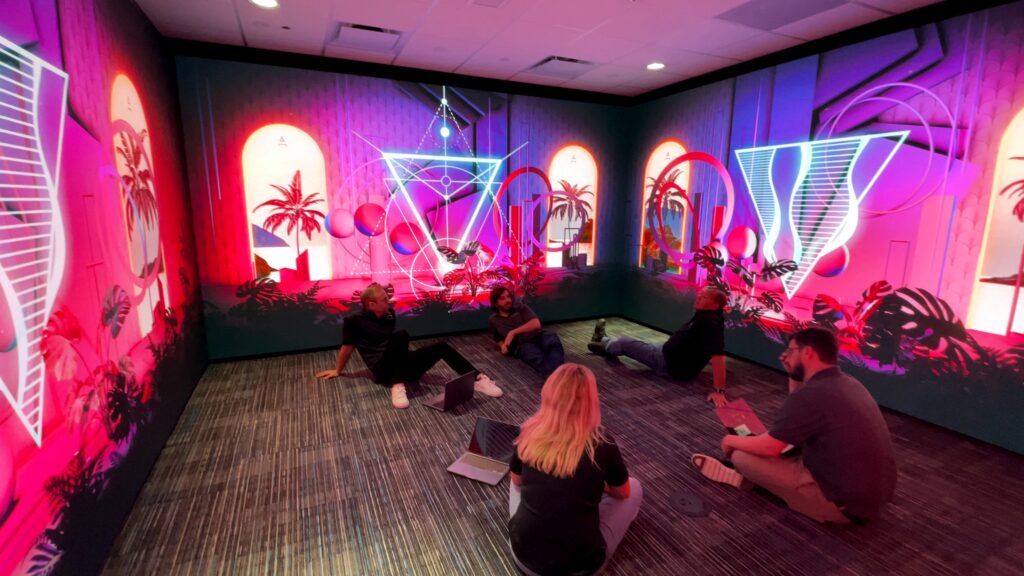
This is where a lot of commercial AV underdelivers. A beautiful LED wall in a lobby with generic house music playing over ceiling speakers isn't sensory layering, it's two systems that happen to share a room. Real layering means the audio system, the lighting system, and the video content are all triggered from the same show control logic, reacting to the same cues, building the same feeling on purpose.
The technology should disappear into the feeling. If a guest notices the screen instead of the story, something upstream went wrong.
Story-Driven Tech, Not Tech for Tech's Sake
It's tempting, especially with how good LED and projection have gotten, to lead a project with "what can this gear do." Themed entertainment design flips that order: you start with the story you want a guest to feel, and only then do you ask which combination of audio, video, lighting, and control makes that feeling land. The tech serves the emotional target, never the other way around.
We apply that same discipline whether we're speccing a themed attraction or a corporate boardroom. What does someone need to feel when they walk in? Confident that this company is buying-power serious? Relaxed enough to actually enjoy a resort stay? Curious enough to keep exploring a museum gallery? That emotional target should drive every AV decision that follows, pixel pitch, speaker placement, lighting zones, control interface, not the reverse.
- Map the guest's emotional arc before you spec a single piece of gear
- Layer audio, video, and lighting off one unified control system, not three separate ones
- Use pacing, quiet moments and loud moments, as deliberately as you use pixels
- Let the story dictate the technology, not the other way around
What This Looks Like Outside a Theme Park
A corporate headquarters lobby can use the same principles as a dark ride queue: build anticipation as visitors approach the building, deliver a clear "wow" moment at the reception desk, then let the space settle into something calmer and more functional as people move deeper into daily work areas. A hotel can treat the porte-cochère, lobby, and guest room corridor as three connected acts instead of three disconnected zones with their own AV budgets. An event space can choreograph lighting and sound cues around the actual program instead of just running "ambient mode" all night.
None of this requires theme-park budgets. It requires theme-park thinking, treating every guest touchpoint as part of one continuous emotional design, mapped and choreographed before the technology gets specified. That's the throughline between the immersive rooms and themed environments we build and the corporate, hospitality, and event spaces we work in every week. If you want to talk through what an emotionally choreographed AV system could look like for your space, our themed entertainment team is a good place to start, or just reach out directly and we'll walk through it together.