People love to ask me what the "coolest" piece of gear is on a project. I get it, projectors with five-figure lumen counts and animatronic figures that track your movement are fun to talk about. But after two decades doing this, the honest answer is that the coolest part was never any single piece of gear. It's getting a dozen different systems, built by a dozen different manufacturers, to behave like they were designed as one thing. That's the actual magic trick behind every museum exhibit, theme park attraction, and immersive experience you've ever walked through and thought, "how did they do that?"
Why Attractions Are Systems Problems, Not Screen Problems
When a client comes to us wanting an immersive exhibit, they usually describe it in terms of the story they want to tell, a walk through space history, a walk-through aquarium, a corporate brand experience. What they're actually asking for is a synchronized system of projection, motion, lighting, and sound, all triggered off the same clock, all surviving eight hours a day of public use without a hiccup. The visual is what gets photographed. The system underneath is what makes it repeatable 400 times a day for ten years.
That distinction matters because it changes how you design. A single beautiful projection-mapped surface is a demo. A projection-mapped surface that has to trigger in sync with a servo-driven prop, cue a directional speaker array, and recover cleanly if a guest walks in front of a sensor at the wrong moment, that's an attraction. The engineering effort isn't in any one layer. It's in the handshakes between layers.
Projection Mapping: Turning Any Surface Into a Canvas
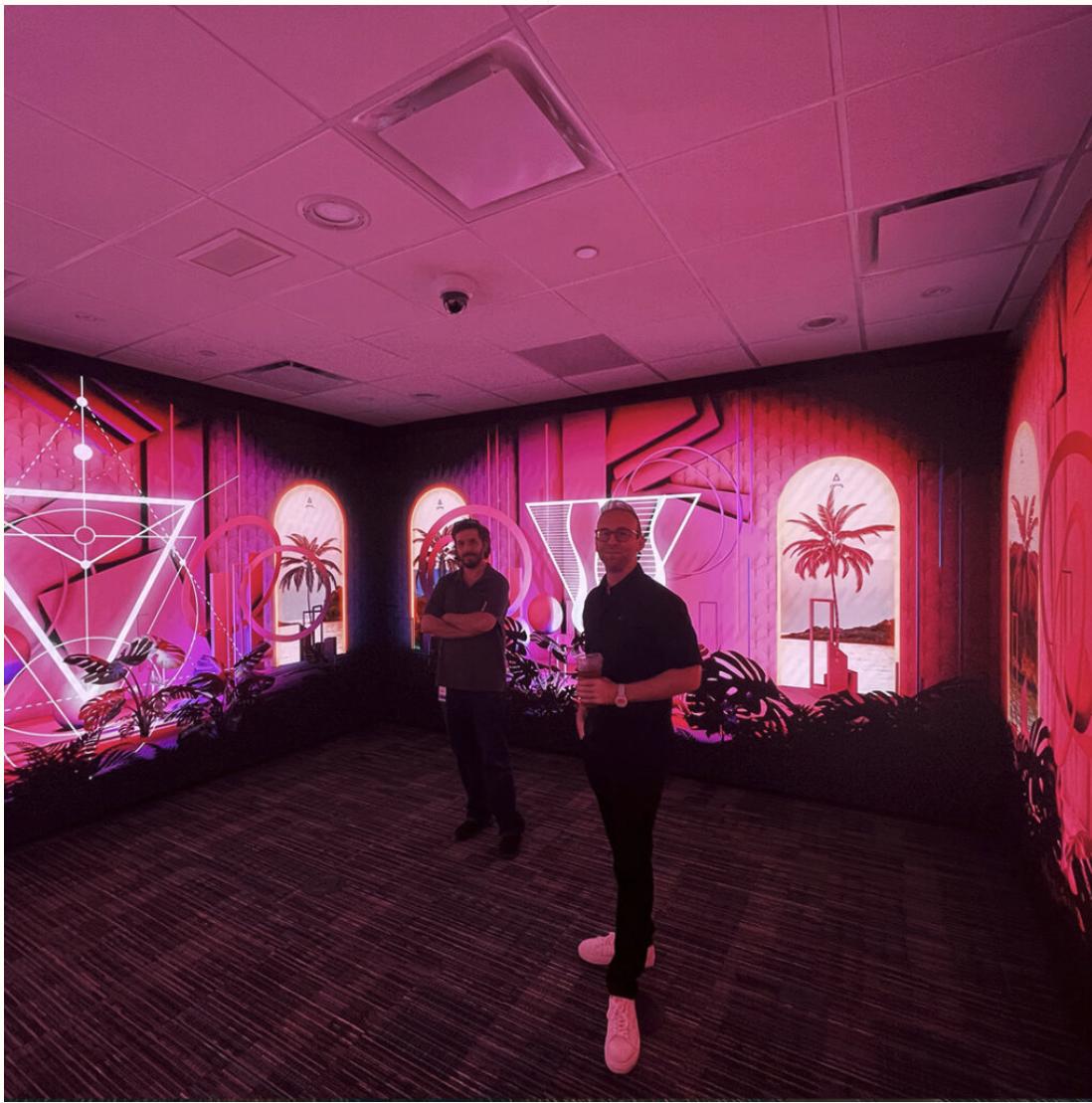
Projection mapping attractions live and die on alignment and brightness headroom. You're rarely projecting onto a flat screen — it's a curved wall, a set piece with texture, sometimes a moving surface. We build the content and the geometry correction together from day one, because retrofitting a mapping solve onto finished content is where projects go over budget. Ambient light control matters just as much as the projector spec sheet; a 20,000-lumen laser projector will still look washed out if you haven't controlled the house lighting bleeding onto the surface.
Our 360-degree immersive wall at the Kennedy Space Center visitor complex is a good example of what this looks like in practice. A fully wrapped environment like that isn't one projector doing one job, it's an array of edge-blended units mapped onto a continuous curved surface, timed to a show control system so guests get a seamless wraparound image rather than visible seams or hot spots. Get the blending and calibration wrong and the whole illusion collapses the moment someone notices where one projector's throw ends and the next begins.
Robotics and Animatronics: The Physical Layer
Animatronics and show robotics add a layer that pure video content doesn't have to deal with: physical safety and mechanical reliability. A servo that's a half-second late looks broken in a way a slightly-late video frame never does, humans are extremely good at noticing when a physical object doesn't move the way it should. That means motion control systems need their own dedicated timing reference, usually synced back to the same master show controller driving the video and audio, so a figure's gesture, a projected effect, and a sound cue all land on the same beat.

We also design for maintenance from the start. Anything with moving parts wears out, that's physics, not a defect. The exhibits that stay in service for a decade are the ones where the integrator planned for accessible service panels, swappable components, and diagnostics that tell a technician exactly which subsystem is misbehaving at 7am before doors open, instead of a guest finding out at 2pm.
Spatial Sound: The Sense Nobody Notices Until It's Wrong
Attraction sound design is the layer people notice least and miss most when it's absent. A visual can be stunning and the experience will still feel flat without directional audio that tells your ear where to look before your eyes catch up. Museum exhibit AV increasingly leans on distributed speaker arrays and object-based audio processing so a sound can appear to originate from a specific point in the room, a rocket engine igniting to your left, a voice that seems to come from inside a display case, rather than a generic wash of stereo sound from ceiling speakers.

The frequency range matters too. Low-end rumble at 40-60 Hz sold through subwoofers gives a launch sequence or an impact moment physical weight you feel in your chest, not just hear. That's a deliberate design choice, tuned to the room's acoustics, not an accident of turning the volume up.
The exhibits people remember aren't the ones with the biggest screen. They're the ones where every sense agreed with every other sense at exactly the same moment.
The Integration Challenge: Making It All Talk to Each Other
Here's the part that doesn't show up in the marketing photos: show control. Every one of these systems, projection, motion, audio, lighting, sometimes environmental effects, needs a shared timeline and a shared trigger source. Get that wrong and you get sync drift, where a show slowly falls out of alignment over the course of a day until a projected flame and an animatronic figure's "reaction" to it are a full second apart. We build these systems around dedicated show controllers and networked timecode specifically so that doesn't happen, with redundancy built in so a single component failure doesn't take the whole experience down mid-show.
A well-integrated attraction needs to account for:
- A single master clock or timecode source all subsystems reference
- Redundant control paths so one failed device doesn't halt the whole show
- Remote diagnostics that flag a fault before a guest ever notices it
- Content and mechanical systems designed together, not bolted on sequentially
- A maintenance plan built into the design, not added after opening day
This is where experience matters more than any spec sheet. We've been doing this long enough to know which failure points tend to bite you six months after opening rather than on day one, and we design around them up front.
What This Means for Your Next Exhibit
If you're planning an attraction, museum exhibit, or brand experience, the biggest mistake we see is treating projection, robotics, and sound as three separate purchase decisions made by three separate vendors. They need to be designed as one system from the earliest concept sketches, because the seams between them are exactly where budgets blow up and shows go dark on opening week. That's the work we do, not just speccing impressive gear, but making sure it all still agrees with itself on day 1,000.
If you're scoping an immersive exhibit or themed attraction, our projection mapping and themed entertainment teams work through exactly this kind of integration daily. Get in touch and let's talk through what your space needs.